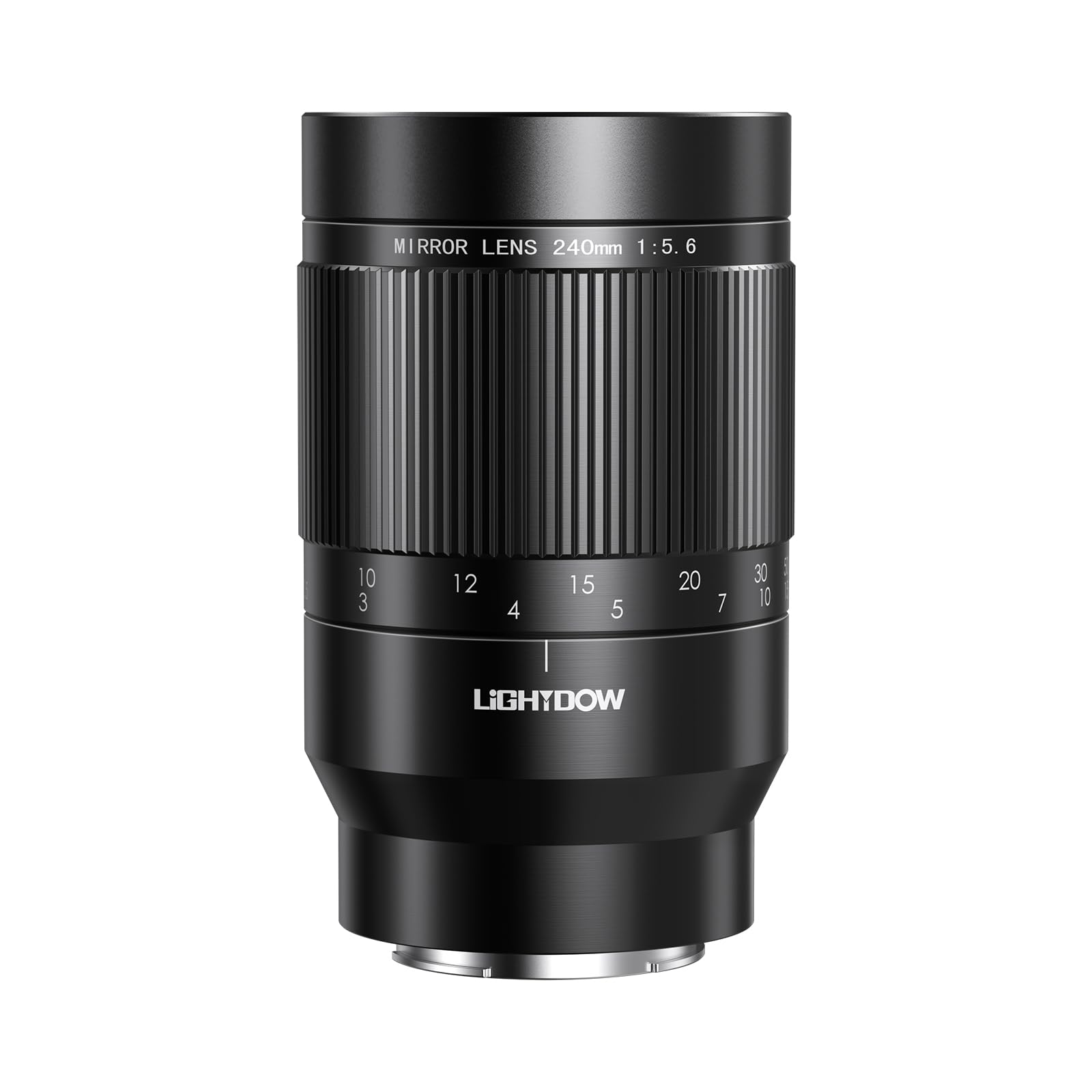
The RF 240mm F5.6 Reflex Lens is a manual focus mirror lens designed for Canon’s RF mount mirrorless cameras, including the EOS R6 Mark II, R5 Mark II, R5, R3, R7, R8, R10, RP, R6, R50, R1, R5 C, R50 V, R100, R, and Ra. This lens offers a fixed 240mm focal length with a constant f/5.6 aperture, utilizing a catadioptric optical design that relies on mirrors instead of refractive glass elements. As a result, it is significantly more compact and lighter than a traditional 240mm telephoto lens, making it an intriguing option for those seeking a portable long-range lens without the bulk. However, the mirror design introduces specific optical characteristics and operational quirks that potential buyers should understand before purchasing.
In real-world use, this lens is likely to appeal to photographers who need a lightweight telephoto solution for outdoor activities such as hiking, wildlife observation, or surveillance, where carrying a large lens is impractical. Its 240mm focal length on full-frame RF bodies provides a moderate telephoto reach, suitable for capturing distant subjects like birds, animals, or architectural details. On APS-C models like the R7 or R10, the effective focal length increases to approximately 384mm, offering even greater reach. The manual focus mechanism requires careful adjustment, and the lens lacks image stabilization, so a steady hand or a tripod is essential for sharp results. The f/5.6 aperture is relatively slow, limiting its use in low-light conditions and making it less ideal for action or indoor sports.
Key functional features include the catadioptric design, which uses a combination of mirrors to fold the optical path, resulting in a short, cylindrical barrel. This design typically produces a distinctive donut-shaped bokeh in out-of-focus highlights, an effect that some find artistic and others distracting. The lens is manual focus only, with a focus ring that offers a long throw for precise adjustments. It has a fixed aperture of f/5.6, meaning exposure must be controlled via shutter speed and ISO. The lens mounts directly to RF cameras without an adapter, and it likely includes electronic contacts for aperture control and EXIF data transmission, though manual focus confirmation may rely on the camera’s focus peaking or magnified view. Build quality is generally solid but may vary; the lens is often constructed with metal and high-quality plastics, but it may not be weather-sealed.
One significant limitation is the manual focus requirement. While focus peaking and magnification assist, achieving critical focus on moving subjects can be challenging, especially without stabilization. The fixed f/5.6 aperture also restricts light gathering, making it unsuitable for dim environments. Additionally, mirror lenses are prone to lower contrast and softer images compared to refractive lenses, particularly wide open, and they may exhibit chromatic aberration and flare. The donut bokeh can be a dealbreaker for portrait or event photographers who prefer smooth background blur. Compared to a traditional 70-200mm f/4 zoom lens, this reflex lens offers a fixed focal length and manual focus, but it is far more portable and affordable. However, the zoom lens provides autofocus, image stabilization, and better optical performance, albeit at a higher price and weight.
Who is this lens for? It suits budget-conscious photographers who want to experiment with long focal lengths without investing in expensive autofocus telephoto lenses. It could be a good fit for landscape photographers who stop down for depth of field and use a tripod, or for those who enjoy the unique rendering of mirror lenses. It is not suitable for fast-paced action, low-light events, or situations requiring quick autofocus and reliable stabilization. Wildlife photographers who need to track moving animals will likely find the manual focus and slow aperture frustrating. Similarly, portrait photographers seeking creamy bokeh will be disappointed by the donut-shaped highlights.
In terms of alternatives, one might consider a used 300mm f/4 or 400mm f/5.6 prime lens with an EF-to-RF adapter, which would offer autofocus and better optics but at a higher cost and weight. Or, for a similar price, a 70-300mm zoom lens might provide more versatility, though with a slower aperture at the long end. The RF 240mm F5.6 Reflex Lens occupies a niche: it is a compact, lightweight option for those who prioritize portability and are willing to accept the trade-offs of manual focus and mirror lens characteristics. It is not a replacement for a conventional telephoto lens but rather a specialized tool for specific scenarios.
Performance expectations should be realistic. In good light, with careful focusing and a steady support, the lens can produce acceptable images, especially when stopped down to f/8 (though the aperture is fixed, some mirror lenses allow exposure adjustment via neutral density filters). However, wide open, images may appear soft with low contrast. Post-processing can improve contrast and sharpness, but the inherent optical limitations remain. The lens is likely to be most satisfying for static subjects in daylight.
Ultimately, the RF 240mm F5.6 Reflex Lens is an affordable entry into super-telephoto territory for Canon RF shooters. It is not without compromises, but for the right user, its compact size and unique optical character could be appealing. As with any niche product, understanding its limitations is key to determining if it fits your needs.