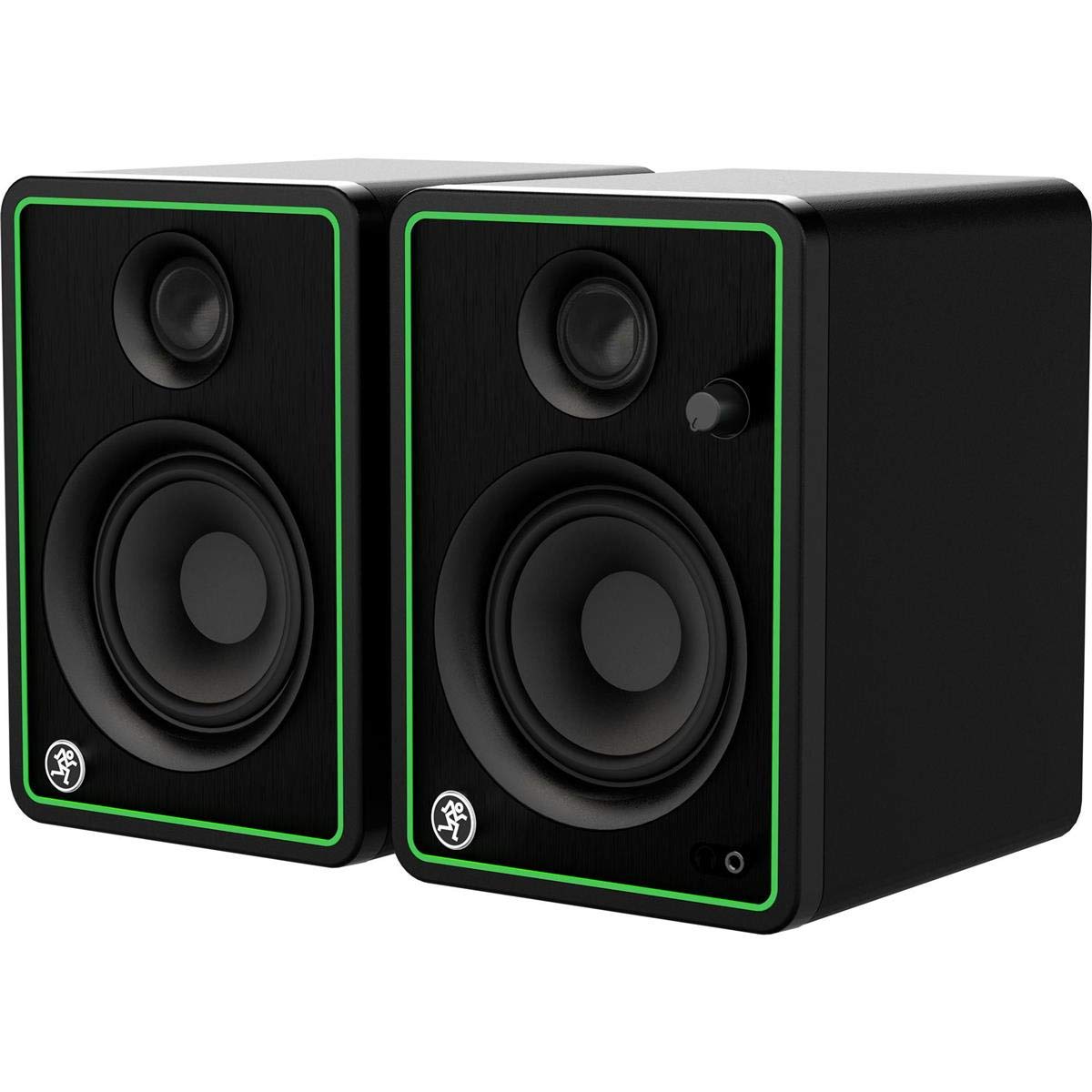
The Mackie CR4-X monitors are a pair of 4.5-inch powered speakers aimed at content creators, casual musicians, and anyone who wants better-than-average desktop audio without breaking the bank. After spending several weeks with them in a home studio and general listening setup, I’ve found them to be a reasonable option for their price range, though they come with some notable trade-offs.
These are compact, self-contained monitors that sit comfortably on a desk or shelf. The 4.5-inch woofer and 0.75-inch silk dome tweeter deliver a frequency response of 70 Hz to 20 kHz. In practice, this means you get clear mids and highs, but the low end is limited—there’s no thumping bass, and you won’t feel sub-bass frequencies. For music production, mixing, or critical listening, this is a limitation you’ll need to work around, perhaps by adding a subwoofer later. For general media consumption, podcasts, YouTube, or even casual gaming, the sound is perfectly acceptable and much clearer than typical computer speakers.
One of the first things I noticed is the build quality. The cabinets are made of molded plastic, not wood, which feels a bit less premium than some competitors in the same price bracket. However, the front baffle has a brushed metal-like finish that looks decent, and the overall design is clean and unobtrusive. The controls are located on the front of the right speaker—a volume knob, power switch, and a headphone jack. This makes adjustments easy, though the volume knob has a bit of a cheap, wobbly feel. The front-firing bass port is a practical choice for desktop use, as it reduces the need for space behind the speakers, but it can also emphasize low-mid frequencies in a way that might not be ideal for precise audio work.
In terms of connectivity, the CR4-X offers both RCA and 1/4-inch TRS inputs, which cover most basic setups. There’s no XLR input, but that’s typical at this price point. The included cables are basic but functional. The power is supplied by an internal amplifier, with 50 watts total (25 watts per channel). This is enough for nearfield listening at moderate volumes, but they won’t fill a large room with sound. Distortion becomes noticeable if you push them too hard, especially in the lower frequencies.
Compared to something like the Edifier R1280T or the Presonus Eris E3.5, the Mackie CR4-X sits in a similar category of budget multimedia monitors. The Edifiers tend to have a warmer, more consumer-friendly sound, while the Mackies lean slightly more toward a neutral, studio-like voicing. However, the Mackies lack the balanced, flat response you’d expect from professional studio monitors like the Yamaha HS series or KRK Rokits—they’re more of a hybrid between a hi-fi speaker and a basic monitor. If you’re doing serious mixing or mastering, you’d likely want to step up to something more accurate. For video editing, voiceovers, or just enjoying music while working, the CR4-X is adequate.
A limitation worth mentioning is the lack of an auto-standby feature. The speakers stay on as long as they’re powered, which means you’ll need to remember to turn them off if you’re concerned about energy use. Also, the power LED on the front is quite bright—some may find it distracting in a dark room. The included isolation pads help reduce desk resonance, but they’re thin and not as effective as aftermarket foam pads.
Who is this product for? It’s best suited for beginners setting up a first home studio on a tight budget, or for general desktop use where you want improved audio fidelity over built-in laptop speakers or cheap computer speakers. It’s also fine for podcasters, streamers, or video editors who need decent monitoring without spending a lot. Who should avoid it? Experienced audio engineers, serious music producers, or anyone who needs accurate low-end reproduction will likely be frustrated by the lack of bass extension and the plastic cabinet resonance. Similarly, if you want a speaker that doubles as a high-quality hi-fi system for a living room, these are too small and underpowered for that purpose.
Overall, the Mackie CR4-X monitors are a functional, affordable entry point into powered nearfield speakers. They do a lot of things reasonably well but excel at nothing. If you’re aware of their limits and work within them, they can be a useful tool. Just don’t expect studio-grade performance from a $150 pair of speakers.