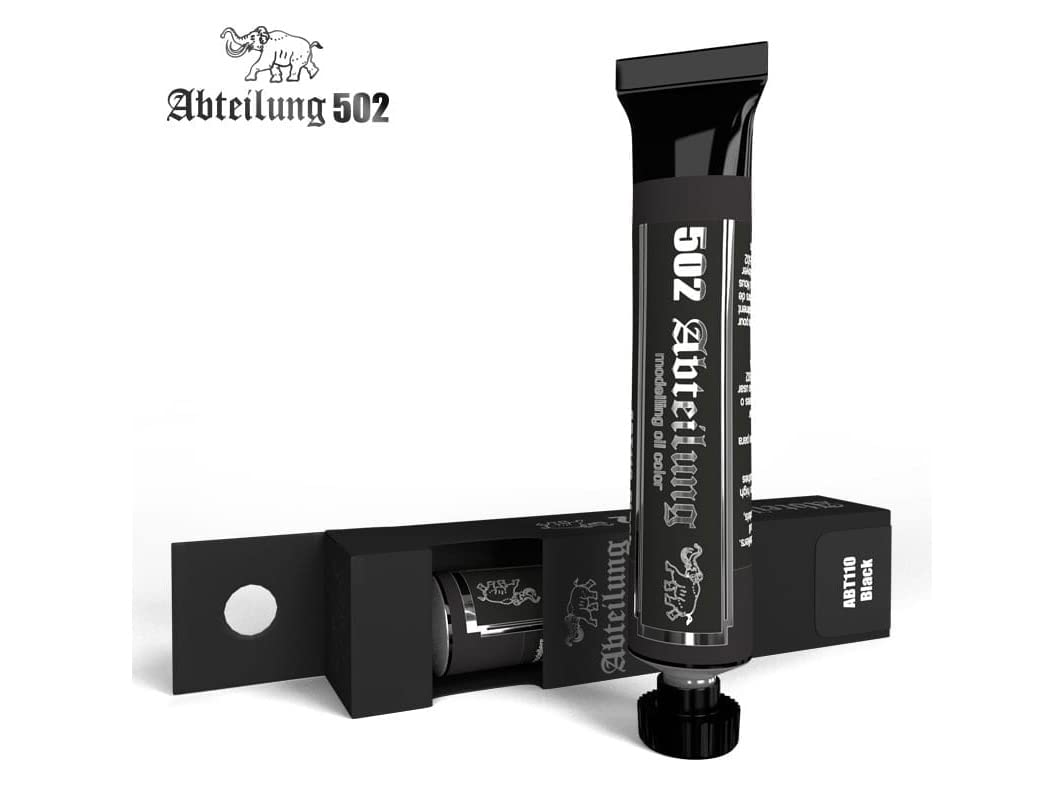
Oil paints occupy a strange place in the modeling hobby. Many builders start with acrylics, add a few enamels for washes, and never quite get around to trying oils because the learning curve sounds steeper than it is. Abteilung 502’s ABT110, a plain black oil color in a small metal tube, is one of those products that makes the jump a little less intimidating, though it is not a magic solution to every weathering problem.
The tube itself is small, as most modeling oil colors are. The paint inside is a fairly stiff, pigment-heavy paste rather than a runny liquid. That consistency matters because it is what allows the paint to be thinned down for washes, filters, and dot weathering without losing all of its color strength. In practice, most modelers squeeze out a tiny amount onto cardboard or an absorbent surface to leach out some of the oil binder before use. That step is not optional if you want predictable results, and it is worth knowing before you start.
Where this black earns its place on a workbench is in the same roles any good black oil serves: pin washes in recesses, panel line accents on armor, subtle grime in figure folds, and dot-filtering where a touch of dark tone helps break up a flat base coat. Because it is an oil, it stays workable for a long time. You can push it around, feather edges with a clean brush dampened in thinner, and remove it almost entirely if you overdo it. That forgiveness is the main reason people put up with the slower drying time. Acrylic washes set quickly and can leave tide marks if you are not careful; this paint gives you room to correct mistakes, which matters a lot when you are learning.
Color-wise, ABT110 is a straightforward black. It is not a blue-black or a warm brown-black, so it behaves predictably when mixed. Mixed with a little burnt umber or raw umber, it makes a serviceable dark grime tone; thinned heavily, it becomes a cool shadow wash. On its own, it can look a bit flat and lifeless if applied heavily, which is a common complaint with pure blacks in weathering. Many experienced modelers prefer to reach for a dark brown or a very dark gray for general washes and save the black for specific jobs like engine grime, rubber, and deep panel lines. That is a fair critique of black oils in general rather than this tube specifically, but it is worth flagging.
Compared with other options, the trade-offs are familiar. Acrylic panel line washes are faster, water-cleanup, and less fussy, but they lack the working time and blendability of oils. Enamel washes sit somewhere in between and are popular for good reason, but they can attack certain paints and plastics if used carelessly. Oils like this one are slower and require solvents for cleanup, which means ventilation and a bit of care. If you already use enamel washes and are happy with them, moving to oils is not automatically an upgrade; it is a different workflow with different strengths. Where oils win is in blending and in the ability to rework an area hours later.
The pigment load is decent for the price point, and a tube this size lasts a long time because you use so little per session. That is one of the less obvious practical advantages: a single tube can serve a modeler for years. The downside is that oils are not a one-product solution. You will want thinner, a palette, absorbent card, and brushes you are willing to dedicate to solvent-based work. The paint is also not something to hand to a beginner without guidance, since solvent handling and drying times can frustrate someone used to acrylics that dry in minutes.
This product suits modelers who already have some experience with washes and want more control over blending, particularly armor, figure, and diorama builders working in 1/35 or larger scales where subtle tonal variation matters. It is less suitable for someone looking for a quick, out-of-the-bottle effect, for younger modelers, or for anyone unwilling to deal with solvents and long drying times. As a basic black in an oil range, ABT110 does its job without drama. It is not exciting, and it will not transform your results on its own, but it is a reliable workhorse for the specific tasks black oil paint is good at.