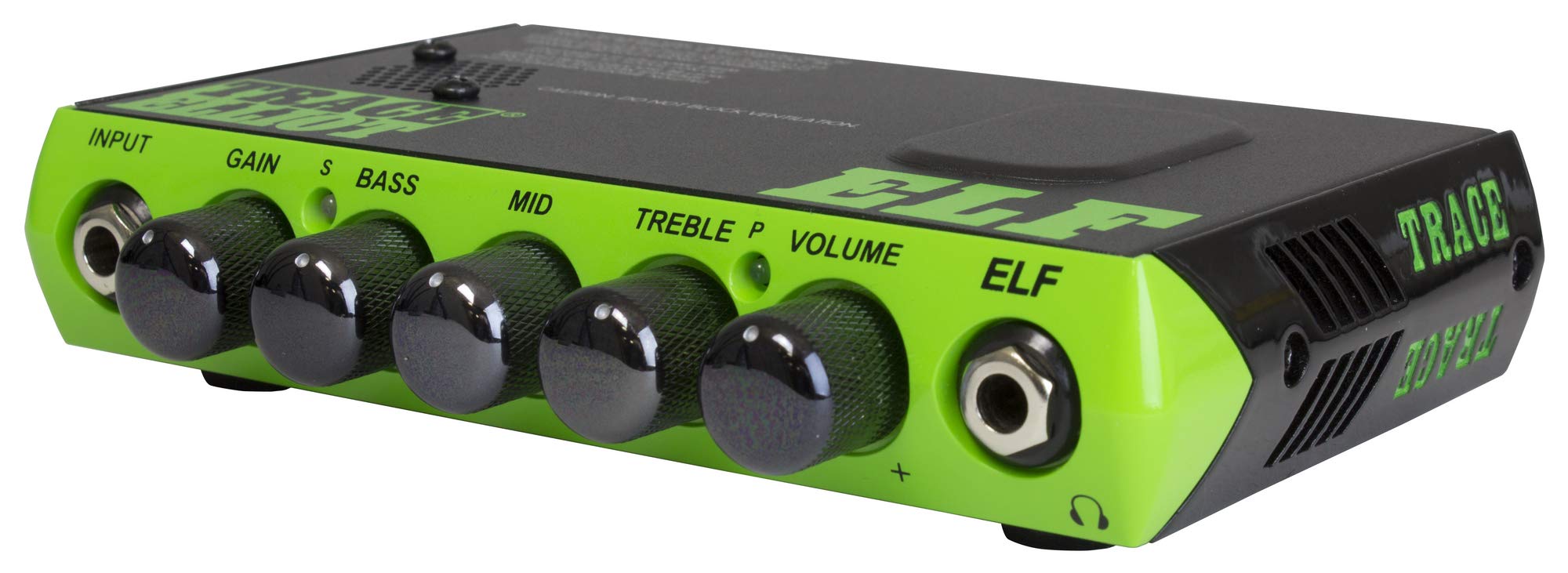
The Trace Elliot ELF is one of those products that seems almost too small to be taken seriously. At roughly the size of a paperback book and weighing around 1.6 pounds, it’s a bass amplifier head that can fit in a gig bag pocket. But don’t let the dimensions fool you: this is a 200-watt Class D amp designed for bassists who need a portable solution without sacrificing tone. In this review, we’ll look at how the ELF performs in real-world settings, what it does well, and where it falls short.
Real-world usage
The ELF is aimed at players who are tired of hauling heavy rigs to rehearsals, small gigs, or jam sessions. It’s also a handy backup for touring musicians who want a safety net in case their main amp fails. In practice, you can pair it with a compact cabinet—say, a 1×10 or 1×12—and have a full rig that weighs less than many bass guitars. I’ve seen it used at coffee shop gigs, church services, and even as a practice amp at home with headphones. The built-in XLR DI output makes it easy to go straight into a PA system, which is a common scenario for smaller venues. The ELF also works well as a studio tool, thanks to its balanced DI and simple controls.
Key features
- Power output: 200 watts RMS at 4 ohms, 130 watts at 8 ohms. That’s enough for small to medium gigs with efficient speakers, but not for loud rock bands without PA support.
- Controls: Gain, bass, middle, treble, and volume. There’s also a switchable input pad for active basses. The EQ is simple but effective, with a surprisingly musical range.
- Connectivity: 1/4-inch input, speakON output, XLR DI out, headphone jack, and an aux input for practice tracks. The headphone jack doubles as a line out, which is handy for recording.
- Build: Metal chassis with a brushed finish. It feels solid despite the light weight. The knobs are plastic but have a decent feel.
- Power supply: External brick, which is a trade-off for the small size. It’s not a dealbreaker, but it’s one more thing to carry.
Performance and tone
The ELF delivers a surprisingly full sound for its size. The EQ is voiced well for bass, with a warm low end and a clear midrange. The treble control can add some bite without getting harsh. It doesn’t have the same heft as a large tube amp, but for solid-state, it holds its own. The gain knob can add a bit of grit when pushed, but it’s not a high-gain distortion machine. At 200 watts, it can keep up with a moderate drummer in a small room, but in a loud band with a heavy-handed drummer, you might find yourself pushing it to its limits. The fan is quiet, which is a plus for studio use.
Limitations
The most obvious trade-off is the external power supply. It’s a wall wart that adds bulk to your gig bag, and if you lose it, you’re stuck. Also, the ELF lacks a built-in tuner, which is common in many modern amps. The DI output is pre-EQ, meaning your front-of-house engineer gets a clean signal without your EQ settings. That can be good or bad depending on your preference. Some players might miss having an effects loop, but for a minimalist amp, it’s understandable. Finally, the 200-watt rating is at 4 ohms; at 8 ohms, you get 130 watts, which might not be enough for larger stages without PA support.
Comparison
Compared to other micro bass heads like the Markbass Nano Mark 300 or the GK MB200, the ELF holds its own in terms of portability and tone. The Markbass offers more power (300 watts) but is larger and heavier. The GK MB200 is similarly sized but has a different EQ voicing. The ELF’s DI and headphone out make it a strong contender for a practice/recording amp, while the others might be more suited for gigging. If you need more power, a class D amp like the Trace Elliot ELF’s bigger brother, the Transit B, might be a better fit, but it’s larger and heavier.
Who it’s for
The ELF is ideal for bassists who need a lightweight backup, a practice amp, or a small-gig solution. It’s great for singer-songwriters, acoustic acts, and anyone playing venues with a PA system. It’s also a good choice for students or hobbyists who want a quality amp without spending a lot. However, it’s not for players who need massive volume for loud rock or metal bands, or those who rely on extensive effects loops and onboard tuning. If you’re a touring professional with a tech, you might find it too limited, but as a backup, it’s a lifesaver.
Final thoughts
The Trace Elliot ELF is a well-executed micro amp that delivers on its promise of portability without completely sacrificing tone. It has its quirks—external power supply, no tuner—but for the right player, those are minor. It’s a tool that solves a specific problem: how to get a good bass sound without breaking your back. If that’s your problem, the ELF is worth a look.