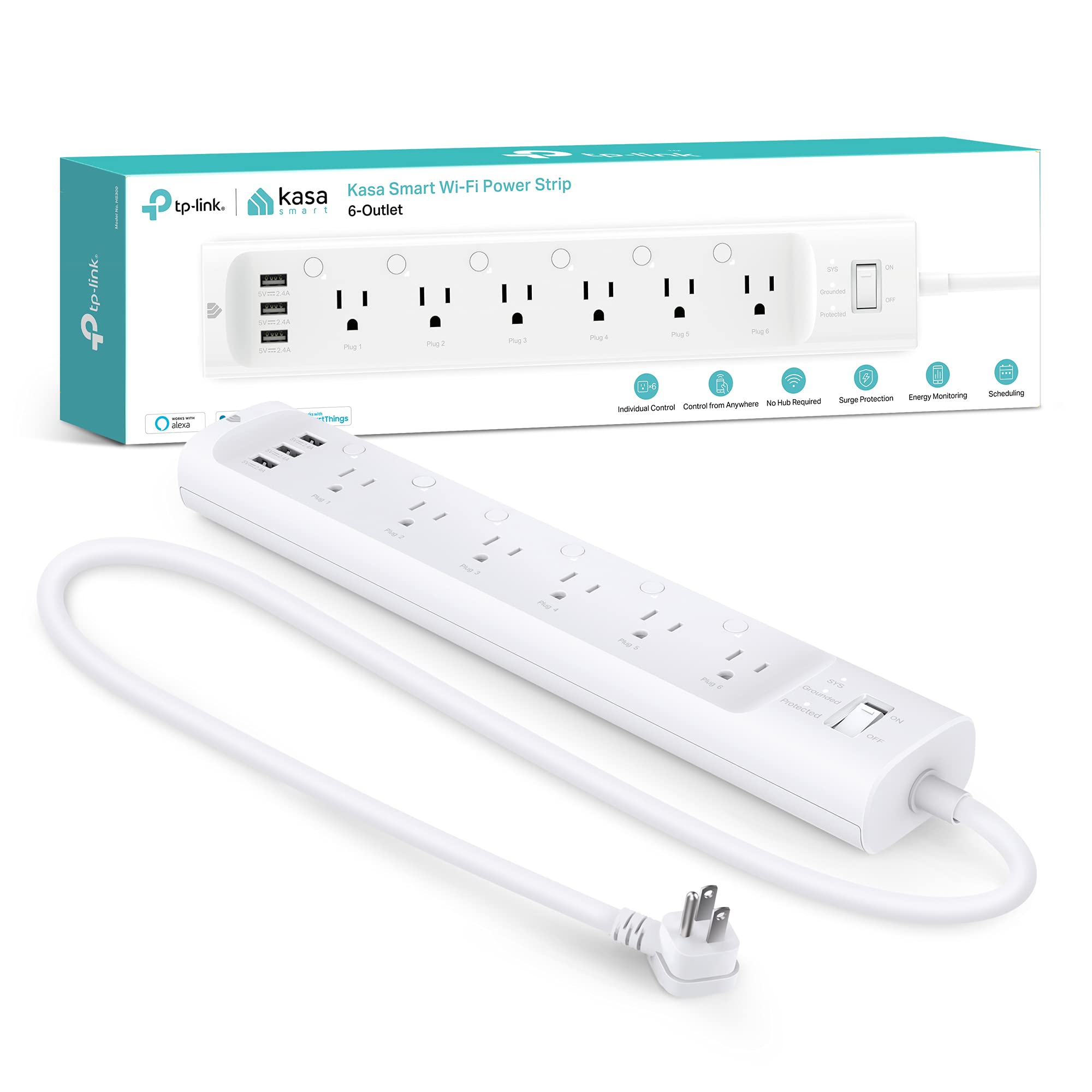
The Kasa Smart Plug Power Strip HS300 is a surge protector that integrates six individually controllable AC outlets and three USB charging ports into a single, flat strip. It is designed for home or office use where you need to manage multiple devices from one location, such as a desk with a monitor, lamp, and phone charger, or an entertainment center with a TV, gaming console, and streaming device. The strip connects to Wi-Fi and works with Amazon Alexa and Google Home for voice control, though it does not require a separate hub.
One of the key functional features is the ability to control each outlet separately through the Kasa app. This means you can turn off a lamp while leaving a router on, or schedule a coffee maker to start in the morning without affecting other plugged-in devices. The app also provides real-time energy monitoring for each outlet, which is useful for tracking power consumption of appliances like a space heater or a desktop computer. The three USB ports are handy for charging phones, tablets, or other gadgets, but they are not individually controllable—they all turn on and off together as a group.
In real-world usage, the HS300 works reliably for most basic smart home tasks. Setting it up via the Kasa app is straightforward: plug it in, connect to your Wi-Fi, and name each outlet. Voice commands via Alexa or Google Assistant respond quickly, though there is a slight delay of about one to two seconds. The energy monitoring feature is accurate enough to give you a rough idea of usage, but it is not as detailed as a dedicated energy meter. Over time, the strip’s flat design can be a bit bulky for tight spaces behind furniture, and the six-foot cord may be short for some setups.
A limitation worth noting is that the HS300 relies on a stable Wi-Fi connection. If your internet goes down or the router resets, you lose remote and voice control until the network is restored, though the outlets remain in their last state. This is a common trade-off with Wi-Fi-based smart plugs compared to Zigbee or Z-Wave alternatives that use local control. Another trade-off is the lack of support for Apple HomeKit or Matter, which limits integration if you are building a mixed-brand smart home ecosystem. Additionally, the USB ports provide a combined output of 2.4 amps, which is sufficient for overnight charging but slower than many dedicated wall chargers.
Compared to a basic power strip without smart features, the HS300 offers clear advantages in convenience and energy management. However, if you only need one or two smart outlets, a simpler smart plug might be cheaper and less bulky. For users who want to control multiple devices in one area, such as a home office or media center, the HS300 is a practical choice. It is also suitable for renters or those who want an easy, no-hub setup.
Who is it for? This strip works well for people who want to automate lamps, fans, or small electronics without complex wiring. It is also good for those curious about energy usage of specific devices. Who is it not for? If you need a compact strip for travel or tight spaces, the HS300’s size may be a problem. If you prioritize local control without internet dependency, or if you use Apple HomeKit heavily, you might prefer a different smart strip or individual plugs.
Overall, the Kasa HS300 is a functional smart power strip that does what it promises, but it is not without compromises. The individual outlet control and energy monitoring are its standout features, while the Wi-Fi dependency and lack of HomeKit support are notable gaps. For the price, it offers decent value if your needs align with its strengths.